
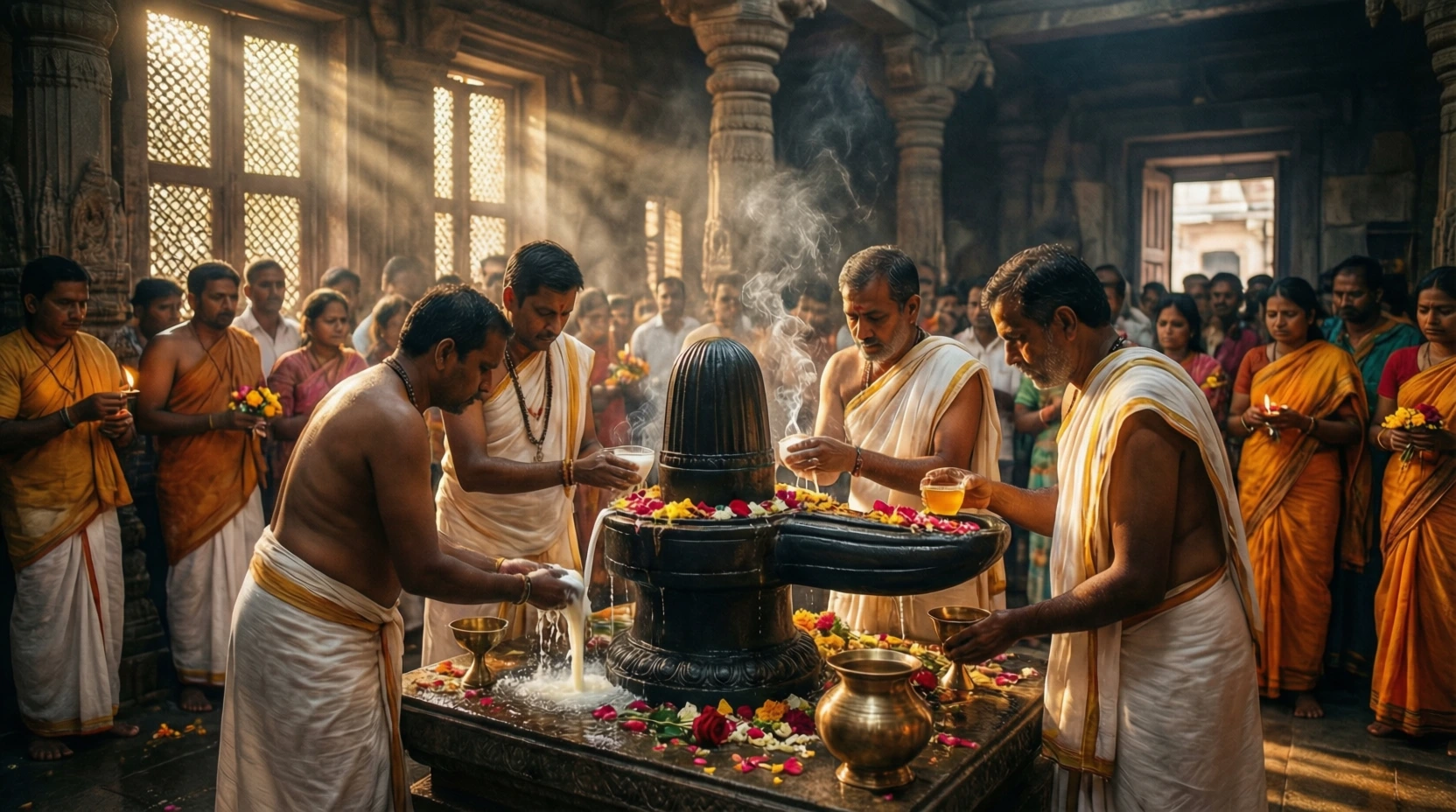
Rudrabhishekam stands as one of Hinduism’s most profound Vedic rituals, dedicated to Lord Shiva in his fierce yet benevolent Rudra form. This ancient ceremony involves the ceremonial bathing of the Shiva Lingam with sacred substances while chanting powerful mantras from the Yajurveda, particularly the Sri Rudram comprising Namakam and Chamakam sections. The ritual’s name derives from “Rudra” (a form of Shiva) and “Abhishekam” (sacred bathing), symbolizing purification of both the deity and the devotee’s consciousness.
Significance and Spiritual Importance
It transcends ordinary worship by creating a vibrational field of divine energy through precise mantra recitation. The ritual invokes Lord Shiva’s compassionate aspect to dissolve negative karma, remove planetary afflictions, and bestow material and spiritual prosperity. Devotees perform this puja during auspicious occasions like Maha Shivratri, Mondays of the Shravan month, or Pradosham to maximize spiritual benefits. The chanting of Rudram’s 108 verses while offering sacred liquids transforms the environment into a sanctified space, neutralizing negative energies and inviting divine grace.
Essential Materials for Rudrabhishekam
The following table outlines the primary materials required for performing Rudrabhishekam:
| Category | Items | Spiritual Significance |
|---|---|---|
| Liquids | Milk, Curd, Honey, Ghee, Sugarcane Juice, Gangajal | Represent purity, nourishment, sweetness, prosperity, and divine blessings |
| Solid Offerings | Bilva leaves, White flowers, Sandalwood paste, Rice | Symbolize devotion, purity, cooling effect, and auspiciousness |
| Ritual Items | Brass vessels, Rudraksha mala, Camphor, Incense sticks | Facilitate proper conduct, mantra counting, divine vision, and fragrance offerings |
| Sacred Substances | Vibhuti (sacred ash), Akshata (unbroken rice), Durva grass | Represent renunciation, blessings, and vitality |
Step-by-Step Procedure
The traditional abhishekam follows a systematic sequence:
- Purification: Begin by cleansing the puja area and taking a ritual bath. Wear clean clothes, preferably white or saffron.
- Sankalpa: Declare your intention for performing the ritual, stating your name, birth star, and purpose.
- Prana Pratishtha: Invoke divine presence into the Shiva Lingam through specific mantras.
- Abhishekam Sequence: Pour the following substances sequentially while chanting appropriate mantras:
- Water for initial purification
- Panchamrit (mixture of milk, curd, honey, ghee, sugar)
- Pure milk
- Curd
- Honey
- Ghee
- Sugarcane juice
- Gangajal (Ganges water)
- Sandalwood paste mixed with water
- Mantra Chanting: Recite Sri Rudram Namakam and Chamakam sections. Ideally, chant Namakam eleven times followed by one Chamakam.
- Offerings: Place Bilva leaves on the Lingam, offer flowers, light incense and ghee lamp, and perform aarti.
- Prayer and Distribution: Conclude with personal prayers and distribute prasad to participants.
Benefits of Rudrabhishekam
Regular performance of Rudrabhishekam yields multiple benefits:
- Dissolution of negative karma and ancestral doshas
- Protection from malefic planetary influences, especially Saturn and Rahu
- Removal of health obstacles and promotion of physical wellbeing
- Enhancement of prosperity, career growth, and material fulfillment
- Spiritual elevation and inner peace
- Cleansing of environment from negative vibrations
- Fulfillment of righteous desires aligned with dharma
Types of Rudrabhishekam
Devotees may choose different forms based on spiritual goals:
- Laghu Rudrabhishekam: Simplified version with basic offerings and shorter mantra recitation
- Ekadasa Rudrabhishekam: Chanting Namakam eleven times with corresponding abhishekam
- Maha Rudrabhishekam: Elaborate ceremony involving 121 repetitions of Rudram with homam
- Rudri Path: Continuous chanting without physical abhishekam, focusing solely on mantra vibration
Frequently Asked Questions
What is the ideal time to perform Rudrabhishekam? The most auspicious times include Mondays, especially during Shravan month, Pradosham (thirteenth lunar day), and Maha Shivratri. Early morning hours before sunrise or during Pradosham period (sunset to 90 minutes after) are considered particularly powerful.
Can Rudrabhishekam be performed at home? Yes, devotees can perform a simplified version at home with basic materials like milk, water, Bilva leaves, and flowers while chanting Om Namah Shivaya or shorter Rudra mantras. For elaborate ceremonies involving full Rudram chanting, guidance from a qualified priest is recommended.
How long does a complete Rudrabhishekam take? A basic Rudrabhishekam takes approximately 45 minutes to one hour. Ekadasa Rudrabhishekam requires three to four hours, while Maha Rudrabhishekam may extend to an entire day depending on repetitions and accompanying rituals.
Is fasting necessary before Rudrabhishekam? While not mandatory, observing a partial or full fast on the day of puja enhances spiritual receptivity. Many devotees consume only fruits or satvik food before the ceremony.
Can women perform Rudrabhishekam? Yes, women can fully participate in and perform Rudrabhishekam. Traditional restrictions during menstrual periods vary by regional customs and personal beliefs, but modern interpretations emphasize devotion over physiological conditions.
What should be done with the abhishekam water afterward? The sanctified water should be collected respectfully and either poured at the base of a sacred tree like Peepal or Bilva, or distributed as prasad to devotees after seeking priestly guidance. It should never be discarded carelessly.